Abstract-- The
focus of this research is to produce a home-made kurut in a traditional way,
namely with a sun drying and alternative drying methods (convective and freeze
drying) and compare the functional properties of home-made kurut dried with
different drying techniques. The pH values of the kurut samples were found between
4.2 and 4.3. Titratable acidity of kurut samples varied between 0.28-0.31%. The
fat content of different kurut samples were found in the range of 8.2% and 8.9%.
The protein content of kurut samples changed from 44.4 to 53.6%. While the
lowest ash content was found in the sun-dried kurut samples (7.8%), the highest
content of ash was determined in the convective-dried kurut samples at 60 oC
(9.1%). The salt content of convective-dried kurut samples at 60 oC
was found to be highest among other samples (7.4%). On the other hand, the
lowest salt level was obtained for sun-dried kurut samples (6.7%).
Keywords-- Home-made kurut, history, functional properties, dried dairy product
I. INTRODUCTION
Milk has a critical role in human nutrition. People are processing
milk into different food materials in order to increase its strength and to produce
and experience the new tastes. Among these food materials, yogurt is one of the
most important and oldest one (Kurt, 1970). Kurut which is a kind of yogurt is
a dairy food product produced in a traditional way and consumed by Turks and
others for many years (Arat, 1992). It is a concentrated food product and could
be preserved for a long time at room temperature without spoiling and losing
its nutritional value. The nutritional value of the Kurut is quite high and it
has essential amounts of animal proteins for healthy life and substances such
as calcium, potassium and phosphorus. Among the foods that are considered as an
important source of nitrogen, eggs have around 13% protein and, meat and fish
have 20% protein while there is about 52% protein in the Kurut. Kurut is a
dried dairy product and its both protein and mineral compositions are quite
high. On the other hand, fat composition is not high, around 5–10% (w/w). The
name of kurut stands for “dry” and is produced by salt addition at a level of
2–3% (w/w) and kneading of cokelek, a fermented
and acid/heat coagulated fresh cheese, following the removal of
whey partion of the cokelek by the use of clot bag technique. The cokelek is formed
as round or oval with the weight of 30–40 g and dried under the sun for around
2 weeks. Following this stage, the dairy product collected named as ‘kurut’ could
be preserved at room temperature over and above 180 days. It is possible to use
this product for soup preparation especially in winter months as well as a
beverage by means of reconstituting with warm water or as a starter culture for
yoghurt production (Akyuz et al., 1993; Patir and Ates, 2002).
Development or extending the
shelf-life of a food products could be accomplished with several processes such
as reducing the moisture ratio or lowering its water activity by dehydration
and/or drying (İzli and Yildiz, 2021; İzli et
al., 2021, Cemal and Yildiz, 2022). Dehydration is one of the oldest
food conservation techniques specifically applied in drying process of several
vegetables including quinces, pears and carrots (Yildiz,
and Izli, 2019a; Yildiz, 2021a; Yildiz, 2021b). Drying process is a technology
where water is moved away in order to restrict or diminish the development of
spoilage microorganism activity (Vega-Mercado et al., 2001; Yildiz, and Izli, 2019b, Yildiz, 2021c).
Drying application is employed in food products and dairy sector, such as milk
powder, dried yoghurt in powder shape and some cereal–yoghurt mixtures such as
tarhana, kishk (Tamime and Robinson, 1999). Moreover, some other dairy
by-products including kurut is produced by drying process. Kurut samples could
be efficiently dried by the help of a convective type dryer in a less time than
that needed to dry them by applying traditional drying process, namely sun
drying. Therefore, the purpose of this study was to explore and compare the physicochemical
properties of kurut produced by sun, convective and freeze-drying.
II. METHODS
A. Kurut Preparation and Drying Process
Flow
chart to prepare Kurut samples in details and drying methods used in the study
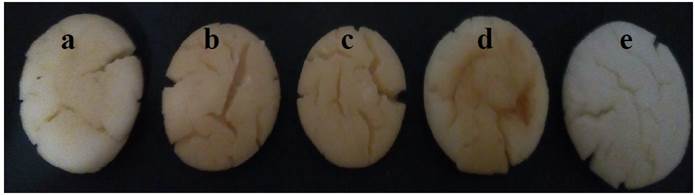
are shown in Fig. 1 and Table 1, respectively. In addition, the appearance of
kurut samples are demonstrated in Fig. 2. Drying process was applied in a
laboratory oven at 40, 50, and 60 oC (Memmert UN55, Germany) and
freeze dryer (Alpha 1–2 LDplus). The drying times were provided in a
supplementary document.
B. Analytical methods
The dry matter, pH, and titratable acidity (TA) of dried kurut
samples were determined following the procedures
Table 1. Treatments used in the study
|
Names
|
Treatments
|
|
SDK
|
Sun-dried Kuruts
|
|
CDK4
|
Convective-dried Kuruts at 40 oC
|
|
CDK5
|
Convective-dried Kuruts at 50 oC
|
|
CDK6
|
Convective-dried Kuruts at 60 oC
|
|
FDK
|
Freeze-dried Kuruts
|
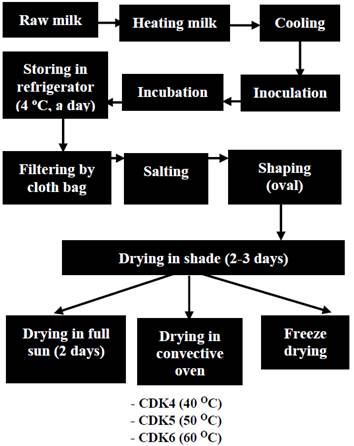
Figure 1. Preparation of Kurut samples
stated by Cemeroğlu (2009). Fat content of dried kuruts was
determined by Van Gulik butyrometer method (Say, 2021). Total nitrogen
substances in dried kurut samples were determined using the Kjeldahl method and
the result was multiplied by 6.38 and the protein content was calculated (AOAC,
1990). The crucibles were kept in the oven until a constant weight. Then,
approximately 1 g of each sample is put into the crucibles. They were kept in
the muffle furnace at 550 °C before the obtaining white ash. By using the
differences between the weighs, the ash content was determined as % (AOAC,
1990). Salt content of dried Kurut samples was determined by the Mohr method.
The salt in the cheese is passed into water and titrated with 0.1 N AgNO3
in the presence of K2CrO4 (Metin and Öztürk, 2009).
C. Statistics
Statistical calculations were obtained using a
randomized plots factorial experimental pattern. The findings were determined
by the assist of the JMP (Version 7.0, SAS Institute Inc., Cary, NC, USA).
Differences among the mean values of the results were determined by Fisher’s
least significant difference (LSD) test at α = 0.05.
III. RESULTS
Dry matter content in dried products has a significant
role in determining the shelf life of the product. In Table 2, the
effect of different drying methods on dry matter content of kurut samples is
shown. The dry matter content of kurut samples was found between 80.3 – 85.7%.
Effect of different drying methods on dry matter of kurut samples was figured
out to be statistically significant (p<0.05). When the temperature increases
in convective drying, the dry matter content increases (Table 2). While the dry
matter was determined as 80.3% for CDK4 samples, it was found as 82.7 and 83.4%
for CDK5 and CDK6 samples, respectively. Similar results were also observed by
Ergene and Arslan (2019) where the cheeses showed higher dry matter content
dried at 60 oC compared to the samples dried at 400C.
While the lowest dry matter was obtained for CDK4 samples (80.3%), the highest
dry matter content (85.7%) was found in kurut samples produced by freeze
drying. The current findings collected from this research were similar to the
findings of Akyuz et al. (1993) where the dry matter of Kurut samples
were found around 85%. The changes in dry matter observed in the kurut samples could
be because of the alterations in the drying stage employed to the kurut
samples.
The pH values of the kurut samples
were found to be quite similar to each other. The pH values of different cheese
types were found between 6.00 and 6.21 for cokelek cheese (Ergene and Arslan,
2019), between 5.21-5.84 in a study on Kashar cheese powders (Gülter, 2011),
and in another study on white cheese powder, pH vales were determined as
5.32-5.51 (Erbay, 2013). Karabulut et al. (2007) found the pH value of
kurut and cokelek cheese as 3.92 and 3.95, respectively. The researchers didn’t
find any significant differences between the cheeses on their pH values in
terms of drying process. Similar findings were observed in our study. The pH
values of the kurut samples were shown in Table 2 and found between 4.2 and 4.3.
No significant differences were determined among the samples. Kurut samples
exhibited a lower pH value than the known pH values (around 4.5) for yogurts
and milk (6.5-6.7) (Tekisen, 2000). This might be associated with an increase
in acidity during the drying of milk which results with a pH decrease.
Similar to the pH value results,
titratable acidity of kurut samples did not show any significant changes. The
titratable acidity (lactic acid%) of kurut samples was tabulated in Table 2. TA
of kurut samples varied between 0.28-0.31%. Titratable acidity determined in
cheese might change depending on the moisture content of cheese, lactose and
salt amount, microorganisms and the storage conditions of the product (Gülter,
2011). Total acidity sources in cheese are lactic acid, acetic acid, formic
acid, butyric acid released as a result of lactose fermentation, free fatty
acids released by lipolysis and free amino acids formed by proteolysis (Solak,
2013). Titratable acidity values of kurut samples in terms of lactic acid were
detected very close to each other (Table 2). Differences between samples were figured
out to be statistically insignificant (p>0.05). In this study, while the
lowest lactic acid % values were determined for
convective-dried kurut samples at 40 oC and
60 °C (0.28), the highest lactic acid % values were found in convective-dried
kurut samples at 50 oC (0.31).
Another factor that directly
affected the chesse texture is fat content. Fat composition has a significant
influence on the quality, content and taste of kurut samples. Cheeses with
higher fat content showed softer texture. The fat content of kurut samples
dried with different techniques are demonstrated in Table 2. Statistical
measurement demonstrated significant differences between the fat content of
kuruts (p<0.05). The fat content of different kurut samples were found in
the range of 8.2 % and 8.9 %. These values are similar to the mean fat content
(8–11%) figured out by several authors in the literature (Eralp, 1953; Akyuz
and Gulumser, 1987; Akyuz et al., 1993). Even though the fat content of
the kurut samples are quite close to each other, the fat contents of the sun-dried
(8.9%) and freeze-dried kurut samples (8.7%) were determined significantly
higher.
Protein is the main component for
cheese structure and so the higher protein content of cheese related to harder
texture of product. Protein content of kurut samples are given in Table 2. The
protein content of kurut samples changed from 44.4 to 53.6%. Drying methods
were found statistically important on protein content. While the highest
protein content was collected for freeze-dried samples (53.6%), the lowest
protein value was determined in convective-dried kuruts at 50 °C (44.3%).
Ash contents of kurut samples are
given in Table 2. The total content of ash in the kuruts was found between 7.8
and 9.1%. The levels of ash content were declared as 4.8% and 1.4% in kurut
samples produced by Eralp (1953) and Akyuz and Gulumser (1987), respectively.
The content of ash stated in those works were lower in comparison with the
levels found in current research. It was observed that the different drying
methods were found statistically important on total ash content of kurut
samples. While the lowest ash content was found in the sun-dried kurut samples
(7.8%), the highest content of ash was determined in the convective-dried kurut
samples at 60 oC (9.1%). This might be as a result of both higher
mineral content and salt matter in CDK6 samples. In addition, different ash
values, as a sign of mineral and salt values, could might be because of the
different titratable acidity and pH values, which affected the absorption of
salt. Analyzing ash helps to figure out the amount and
type of minerals in the food product and is important because the amount of
minerals can induce the physicochemical features of food materials in addition
to decrease the growth of microorganisms. So, mineral composition is a crucial
element in a food products’ nutritional value, quality and, microbial
development (Zhu et al., 2022).
Salt levels of kurut samples are
presented in Table 2. Statistical changes in salt levels of kurut samples
caused by different drying methods were found to be significant (p<0.05).
The salt content of convective-dried kurut samples at 60 oC was
found to be highest among other samples (7.4%). On the contrary, the lowest
salt level was achieved for sun-dried kurut samples (6.7%). In the study, the
salt rate was determined as 9.95% (Karabulut et al. 2007). In our study, the
salt level was found lower than this value changing from 6.7 to 7.4%. The
purpose of salt addition into the food products is to improve the taste, aroma
and product durability as well as product quality (Belz
et al, 2012). Different levels of salt were observed in those
food product samples which could be because of the preferred taste structure
coming from the addition of several amount of salt to the food products.
Compared with yoghurt, kurut is characterized by a low content of sodium and
potassium. The medium sodium content of the kurut samples was lower compared to
the yoghurt, which can be the reason of add the products in low-sodium diets
(Zhang et al., 2008). The positive relationship between ash and salt
content of kurut samples was determined. The higher the ash content, the higher
the salt content, and vice versa. While the highest ash and salt content were
determined for CDK6 samples, the lowest salt and ash content were determined
for SDK samples (Table 2).
IV. CONCLUSIONS
Kurut has been made in several areas of Turkey in a traditional way
and desires to be well-known in the dairy industry. The findings of the current
research showed that the kurut samples can be dried effectively by applying a
convective and freeze drying in a shorter time than that required to dry them
by traditional drying process, namely sun drying. In this regard, it is
possible to modernize the production methods of kurut in order to encourage its
fabrication not only in the rural parts but also in the urban areas, thus
suggesting it for consumption by larger population groups. Nowadays, large
amounts of money are spent on cold storage of food materials, and drying of
yogurt could be a promising way for the preservation of food products. The
drying process is much more cheaper and more suitable compared to the cold
storage technique which requires less labour and equipment. This process is
effective on improved shelf life for dairy products. All in all, yogurt with a
shelf life of 7 days might be processed into a long-lasting product in the
structure of kurut. The modernized production process, preservation method as
well as handling circumstances during the manufacturing stage and drying
application of kurut could also improve the reduction of bacterial load.
REFERENCES
Akyuz, N., Coskun, H., Bakirci, I. and
Con, A.H. (1993) Van yoresinde imal edilen Kurutlar uzerinde bir arastırma. Gıda. 18,
253–257.
Akyuz, N. and Gulumser, S. (1987)
Kurutun yapilisi ve bilesimi uzerine bir arastirma. Gıda. 12,
185–191.
AOAC. (1990) Official Methods of
Analysis of the Association of Official Analytical Chemistry, 15th edn.
Association of Official Chemists, Gaithersburg.
Arat, R.R. (1992) Eski Turk Yazmasi
Kutadgu Bilig’in Cevirisi. Turk Tarih Kurumu Yayınları Yayın No: 335, Ankara:
Turk Tarih Kurumu Basımevi, Basım. 3, 321.
Belz, M.C.E., Ryan
L.A.M. and Arendt E.K. (2012) The Impact of Salt Reduction in Bread: A Review. Crit.
Rev. Food Sci. Nutr. 52, 514-524.
Cemal, D. and
Yildiz, G. (2022) The effect of drying
temperature, cutting types, storage degree and period on physical, chemical and
physicochemical properties of red capia pepper. Lat. Am. Appl. Res.
52, 67-72.
Cemeroğlu, B. (2009) Meyve ve Sebze
İşleme Teknolojisi, Gıda Teknolojisi Yayınları. No:
39 2. cilt, 3. Baskı Ankara.
Eralp, M. (1953) Kurutun yapilisi ve terkibi.
Ataturk Universtesi Ziraat Fakultesi Yilligi. 3, 201–208.
Erbay, Z. (2013) Püskürtmeli
kurutucuda beyaz peynir tozu üretim optimizasyonu ve peynir suyu ile
maltodekstrin kullanımının ürün kalitesi ve depolama stabilitesi üzerine
etkisi. Doktora Tezi, Ege Üniversitesi Fen
Bilimleri Enstitüsü, İzmir.
Ergene, G. and Arslan, S. (2019)
Chemical and sensory characteristics of dried Çökelek cheeses at different
temperatures. J. Food Process. Pres. 43, e13985.
Gülter, S. (2011) Dondurarak kurutulan
kaşar peyniri tozlarının özellikleri üzerine peynirin üretim yönteminin, yağ
oranının ve olgunluğunun depolama sürecindeki etkileri. Yüksek lisans
tezi, Çukurova Üniversitesi Fen Bilimleri Enstitüsü, Adana.
İzli, G. and
Yildiz, G. (2021) Evaluation of the high intensity ultrasound
pre-treatment effects on the physical properties and bioactive compounds of
convective dried quince samples. Int. J.
Fruit Sci. 21, 645-656.
İzli, G., Yildiz,
G. and Berk, S.E. (2021) Quality retention in pumpkin powder dried by combined
microwave-convective drying. J. Food Sci. Technol. 59, 1558-1569.
Karabulut, İ., Hayaloğlu, A. and
Yıldırım, H. (2007) Thin-layer drying characteristics of kurut, a Turkish dried
dairy by-product. Int. J. Food Sci. Technol. 42, 1080–1086.
Kurt, A. (1970) Yogurdun tarihcesi ve
Dunya yuzune yayilisi. Ataturk Universitesi Ziraat Fakultesi Dergisi
172–175.
Metin, M. and Öztürk, G.F. (2009) Süt
ve Mamülleri Analiz Yöntemleri (Duyusal, Fizksel ve Kimyasal Analizler).
İzmir: Ege Meslek Yüksekokulu Basımevi.
Patir, B. and Ates,
G. (2002) Investigations on some microbiological and chemical features of
‘‘Kurut’’ Turkish. Journal of Veterinary Science. 26, 785–792.
Say, D. (2021) Physicochemical
composition, nitrogen fraction and volatile profiles of goat cheese made with
artisanal liquid coagulant. J Food Sci. Technol. https://doi.org/10.1007/s13197-021-05266-3
Solak, B.B. (2013) Farkli tip
peynirler kullanılarak üretilen eritme peynirin üretimi esnasında
uygulanan işlem parametrelerinin peynirin bazı özelliklerine etkisi. Doktora
tezi, Selçuk Üniversitesi, Fen Bilimleri Enstitüsü, Konya.
Tekinsen, O.C. (2000) Sut Ürunleri
Teknolojisi. Selcuk Universitesi Basimevi. Konya, Turkey: 1. Baski,
86.
Vega-Mercado, H.,
Gongora-Nieto, M.M. and Barbosa-Canovas, G.V. (2001) Advances in dehydration of
foods. J. Food Eng. 49, 271–289.
Yildiz, G. and
Izli, G. (2019a) The effect of ultrasound pretreatment on quality attributes of
freeze-dried quince slices: Physical properties and bioactive compounds. J. Food
Process. Eng. 42, e13223.
Yildiz, G. and
Izli, G. (2019b) Influence of microwave and
microwave-convective drying on the drying kinetics and quality characteristics
of pomelo. J. Food Process Pres. 43, e13812.
Yildiz, G. (2021a) The Effect of High
Intensity Ultrasound Pre-treatment on the Functional Properties of
Microwave-dried Pears (Pyrus communis). Lat. Am. Appl. Res. 51,133-137.
Yildiz, G. (2021b) Color,
microstructure, physicochemical, textural and sensory properties with the
retention of secondary metabolites in convective-, microwave- and freeze-dried
carrot (Daucus carota) slices. Br. Food J. https://doi.org/10.1108/BFJ-03-2021-0308
Yildiz, G. (2021c) The Effect of Novel
Microwave-Convective Drying on the Functional Properties of Dried-Pears (Pyrus
communis). Curr. Microw Chem. 8, 22-26.
Zhang, H., Xu, J.,
Wang, J., Menghebilige, Sun, T., Li, H. and Guo, M. (2008) A survey on chemical
and microbiological composition of kurut, naturally fermented yak milk from
Qinghai in China. Food Control. 19, 578-586.
Zhu, X., Healy, L.E., Sevindik, O., Sun,
D.W., Selli, S., Kelebek, H. and Tiwari, B. K. (2022) Impacts of novel
blanching treatments combined with commercial drying methods on the
physicochemical properties of Irish brown seaweed Alaria esculenta. Food
Chem. 369, 130949.
Received: December 18, 2021
Sent to Subject Editor: December 22, 2021
Accepted: April 16, 2022
Recommended by Subject Editor Sebastián Collins