QUANTUM CHEMICAL STUDY FOR THE TOXICITY PREDICTION

OF SULFONAMIDE ANTIBIOTICS WITH QUANTITATIVE STRUCTURE – ACTIVITY RELATIONSHIP


S. AYDOGDU   and   A. HATIPOGLU

Yıldız Technical University Chemistry Department, 34220, İstanbul, Turkey.

hatiparzu@yahoo.com


Cite this article as:

S. AYDOGDU   and   A. HATIPOGLU  (2021) “QUANTUM CHEMICAL STUDY FOR THE TOXICITY PREDICTION OF SULFONAMIDE ANTIBIOTICS WITH QUANTITATIVE STRUCTURE – ACTIVITY RELATIONSHIP”, Latin American Applied Research, 51 (1), pp  7-13.


Abstract-- Sulfonamides are one of the most important classes of chemicals found in the aquatic environment, as a pollutant due to excessive consumption. The DFT- B3LYP method with the basis set 6-311++G (d,p), was employed to calculate various quantum chemical descriptors of sulfonamide molecules. A quantitative structure activity relationship (QSAR) study was performed for the toxicity value LD50 of sulfonamides, with their quantum chemical descriptors, by multi linear regression. The QSAR models were validated by internally and externally. The best multilinear equation with correlation coefficient, R, and the cross-validation leave-one-out correlation coefficient, Q2, values were 0.9528 and 0.8556, respectively The results show that the QSAR models have both favourable estimation stability and good prediction power.

Keywords-- DFT, sulfonamides, quantum chemical descriptors, multi linear regression.

I. INTRODUCTION

Sulfonamides (SAs), one of the most important classes of chemicals, are widely used in aquaculture, livestock husbandry and human medicine (Li et al., 2016). They have been used in high volumes for several decades because of their effectiveness and inexpensiveness (Chandran et al., 2011). As a consequence of excessive consumption of SAs, they are frequently detected in the aquatic environment and accumulated the in the food chain (Qin et al., 2016; Lu et al., 2015; Yang et al., 2010; Shah et al., 2015; Voigt et al., 2017). This problem has become important due to the potential toxicity for human health and all living organisms (Mondal et al., 2015; Guo et al., 2012).

Testing toxicity is often restricted by its high cost, time consuming experimental procedures, public objection to animal testing and so on. Theoretical predicted methods are considered as a rapid and cost-effective alternative for experimental evaluations. Among them, quantitative structure activity relationship (QSAR) analyses are widely used to evaluate the relationship between structures of pollutants and their toxicity value. A QSAR model can be constructed by appropriate descriptors, whether by using topological, quantum chemical, geometrical or spectral descriptors. Among them, quantum chemical descriptors are very useful, and have recently become more important because of their accuracy and reliability to characterize electronic properties of molecules (Eldred and Jurs, 1999; Zhu et al., 2014; Paukku and Hill, 2012; Chen et al., 2017).

Over the last few decades, several experimental studies about the acute toxicity of SA molecules on different test organisms have been reported in aquatic (Park and Choi, 2008; Baran et al., 2006; De Liguoro et al., 2010; Isidori et al., 2005; Białk-Bielinska et al., 2017), terrestrial enviroments (Białk-Bielinska et al., 2011) and in food samples (Hiba et al., 2016). Most of the toxicity experiments have been done in aerobic environment conditions (Zou et al., 2012), while Qin et al. (2016) have examined the toxicities of SA molecules both in aeorobic and aneorobic conditions. The chronic toxicity and the relationship between the acute and chronic toxicity of SA molecules have also been studied by several researchers (Zou et al., 2013; Long et al., 2016; Yao et al., 2013; De Liguoro et al., 2009; Bartlett et al., 2013; Wang et al., 2017; Jiang et al., 2010). However, information on sulfonamide toxicity is still insufficient, and risk assessments for these compounds need to be improved. According to our literature review, until now, toxicity studies of SAs based on quantum chemical calculations have not been reported.

In this study, the structures of SA molecules were investigated theoretically, with the purpose of finding exact quantum chemical descriptors for predicting toxicity of SAs. Various quantum chemical descriptors such as the difference in energy between frontier orbitals (), chemical potential (), hardness (), dipole moment (), sulfur atom’s charge () and octanol-water partition cofficient (), were used to develop QSAR models for the toxicity value  of SA molecules. The obtained models were validated internally and externally. Among all the calculated quantum chemical descriptors, the best ones were found via statistical analysis.

II. METHODS
A. Data set

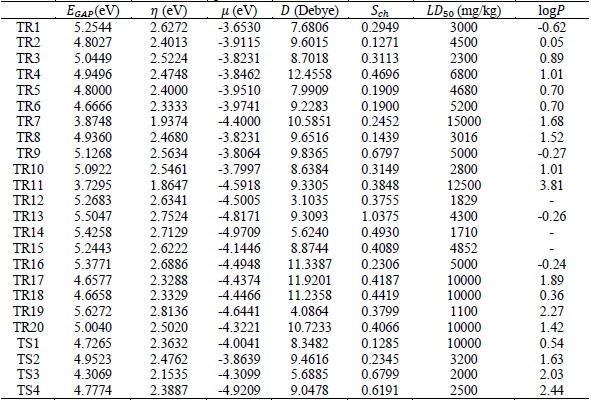
The general structure of SAs were given in Fig. 1. In this study, the structures of 24 SA molecules were investigated theoretically. The data set for SA molecules was divided into a training set (consisting of 20 molecules) and a test set of 4 molecules. The structures of SA molecules are shown in Fig. 2 for the training set, and Fig. 3 for test set. Toxicity is quantified in terms of LD50, which means the amount of chemical mg.kg-1 per body weight that causes the death of 50 % of test animals. The oral lethal dose LD50 values for mouse oral and the octanol  water coefficient, , were obtained from the literature and are summarized in Table 1 (Toxnet, 2017).
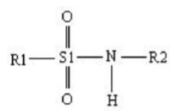


Figure 1. General structure of sulfonamides.

B. Computational Details

In this study, all computational calculations were carried out using the Gaussian 09 software suite (Frisch et al., 2009). The geometries of 20 SAs of the training set and 4 SAs of the test set were optimized by density functional theory (DFT). The DFT calculations were carried out by the hybrid B3LYP functional, which combines HF and Becke exchange terms with the Lee–Yang–Parr correlation functional by using 6-311++G(d,p) basis set (Hehre et al., 1976). Vibrational frequency analyzes were also calculated at the optimized geometry to ensure that the optimized structures are at the stationary points corresponding to local minima without any imaginary frequency. The solvation effects were computed using CPCM as the solvation model. The solvent was water at 25°C, with dielectric constant .

C. Molecular Descriptors

Quantum chemical descriptors are derived within the framework of the density functional theory. These descriptors provide valuable information about reactivity of molecules. In this study, we have calculated the global descriptors such as chemical potential μ and hardness η. According to DFT, chemical potential and hardness are given by:
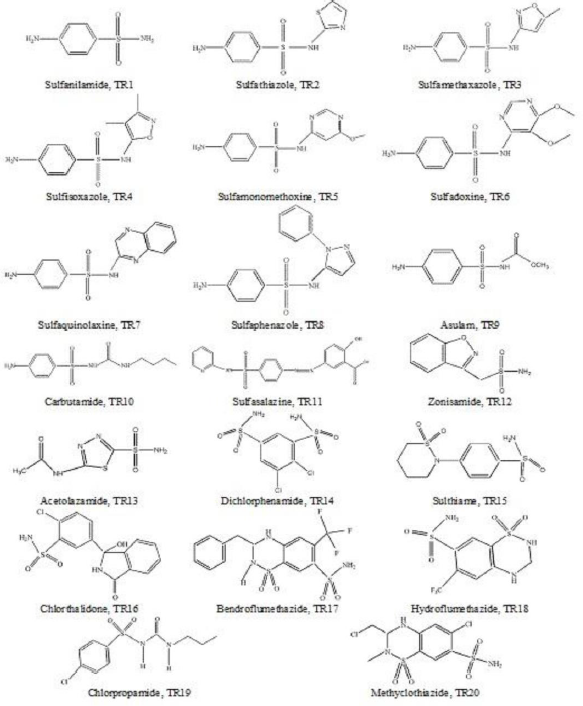
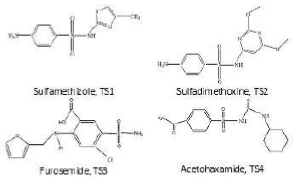
Figure 2. Structures of the training set.


Figure 3. Structures of the test set.


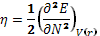
,                    (1)

and

,              (2)

where  is the electronic energy,  is the number of electrons and  is the potential due to the nuclei (Pearson, 1989; Geerlings et al., 2003). Working definitions of chemical potential and hardness are as follows,

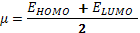
,                          (3)

and

,                          (4)

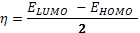
where  and  are the ionization potential and electron affinity of a system, respectively. According the Koopmans theorem (Young, 2001), these energies can be approached by the frontier orbitals, ionization potential and electron affinity approximately equal to the negative value of  and , respectively. Thus  and  can be expressed as,

, (5)

and

. (6)

All calculated descriptors such as hardness, chemical potential, dipole moment, charge of sulfur atom and energy differences between frontier orbitals are listed in Table 1.

D. Statistical Analysis

The toxicity of SA molecules were investigated by means of the multiple linear regression (MLR) technique. Multi linear regression is a common method used in QSAR studies. In MLR equations, the logarithm of toxicity value, log LD50, was used as dependent variable, and the quantum chemical descriptors as the independent variables. Stepwise regression analysis based on forward selection was used to select the most effective variables. According to the stepwise regression, a successive regression equation was derived in which variables were added until optimum values of statistical criteria were obtained (Chaterjee and Hadi 2006). Statistical qualities of the derived equations were tested by parameters such as correlation coefficient (), regression coefficient (), the Fischer statistics () and standard deviation () values. Testing stability and predictive power of the models is an important step in QSAR study. So the models were validated internally and externally. The cross validation is one of the most popular methods for internal validation. In this study, internal predictive power of the models were evaluated by the “leave-one-out” (LOO) cross validation method. In a LOO procedure one compound is removed from the dataset and the toxicity is correlated using the rest of the dataset. Cross validation provides the values of cross-validation correlation coefficient (Q2), predicted residual sum of squares (PRESS), sum of the squares of response (SSY) and PRESS/SSY for testing the predictive power of models (Ray, 2016; Consonni et al., 2010).


Table 1. Descriptors of the studied sulfonamides molecules.


Table 2. Statistical parameters for QSAR models.


III. RESULTS AND DISCUSSION

QSAR studies were performed on the training set of SA molecules. The toxicity values of mouse oral log LD50 were correlated with quantum chemical descriptors to develop QSAR models by stepwise multiple linear regression. According to the stepwise regression, successive regression equations were derived in which parameters were added until  was higher than 0.6. According to many researchers,  shows that the equation is statistically significant (Djeradi et al., 2014). The obtained multiple linear regression equations, with the highest statistical quality, were chosen as models, and our best four models are given in Table 2 with their statistical parameters.

It can be seen that model I has good statistical characteristics, as indicated by its ,  and  values. According to this model, the hardness had an important effect on the the toxicity of SAs. Hardness is a measure of the stability and reactivity of a molecule. The negative coefficient of hardness demonstrated that the higher the reactivity, the greater was the toxicity. On the other hand,  and  were positively correlated with , and their effects were mild. The dipole moment shows the polarity of a molecule, and it is effective for various physicochemical properties such as charge distribution (Karelson, and Lobanov, 1997). It was also important the role played by atomic charges on the chemical properties of molecules (Paukku and Hill, 2012). The sulfur atom, which is shown as S1 in Fig. 1, had the highest Mulliken atomic charge in the studied molecules used as descriptor.

In the same way, another QSAR model was developed as model II. The relationship between the descriptors and the toxicity was charecterized by ,  and . In model II, a negative correlation was found between the  and toxicity. Molecules with small value of  are more prone to interact with other molecules, potentially resulting in a higher toxicity. According to this model, the dipole moment affects toxicity positively, while the chemical potential had a negative correlation. The dipole moment had the smallest correlation coefficient in all models, so it had slight effect on the toxicity of molecules.

In model III, the statistical parameters were ,  and . In this model, it was also demonsrated that dipole moment contributed positively, while octanol-water coefficient and  were negatively correlated with toxicity. The toxicity increases with decrease  and . Octanol-water coefficient is an important parameter, and it is the most common descriptor used in QSAR studies. It is the ability of a compound to penetrate the cell membrane and reach the interacting sites and concentrate on organisms (Hansch, 1976).

Model IV was found to be the best QSAR model with statistical parameters ,  and . In model IV,  was positively correlated in contrast, ,  and  were negatively correlated with . The chemical potential had the smallest correlation coefficient; it measures the tendency of the electrons to escape from the system.  had the biggest correlation coefficient in models II, III and IV. As a consequence,  was the significant descriptor for the toxicity.

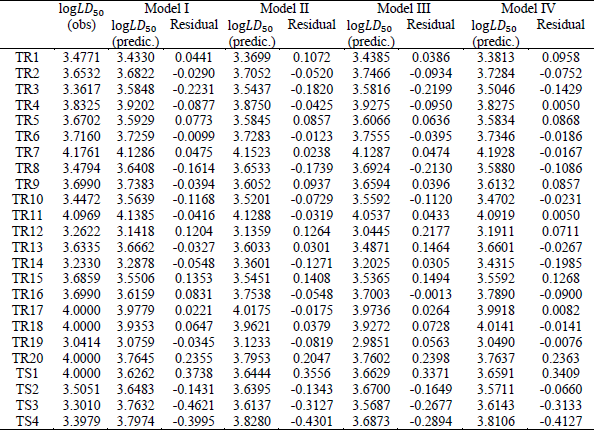
A high regression coefficient and low standart deviation confirmed that the predicted model is statistically significant (Chaterjee and Hadi, 2006). In all the above models,  was  and   , indicating that these models were statistically significant. To confirm our findings, the predicted toxicity of SA molecules by all model equations, were compared with the observed toxicity value  listed in Table 3. As seen in the table, the predicted toxicity values agree well within the observed ones. The residual is the difference between observed and calculated .

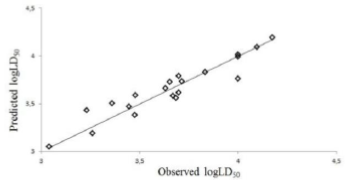
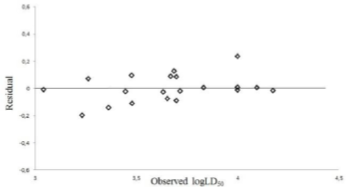
A plot between the observed and predicted  values is shown in Fig 4 for our best model IV. In the plot, all the points were close to the ideal line. In addition, the residuals of the predicted values of the toxicity against the observed values, are shown in Fig 5. Since most of the calculated residuals are distributed on both sides of the zero line, a conclusion may be drawn that there is no systematic error in the development of the present models.

A. Validation of the Models

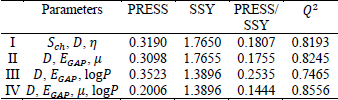
In order to check the predictive power and generalization ability of the models, both internal and external validations were performed. We used LOO cross-validation methodology for deciding the predictive power of the derived models, and we have evaluated cross validation parameters , PRESS and SSY. Calculated cross validation parameters are given in Table 4.

Generally, when the value  is bigger than 0.5, the model is considered to have predictive power (Zhu et al., 2014), the obtained  values were , indicated that the models were useful for predicting the toxicity. If PRESS is smaller than SSY, the model predicts better than chance and the developed model could be considered statistically significant. The ratio PRESS/ SSY can be used to calculate the approximate confidence interval for a prediction. To be an acceptable model, the ratio of PRESS/SSY ought to be smaller than 0.4 (Wold, 1991). As seen in Table 4, our PRESS/SSY ratio ranges between 0.1444–0.2535 indicating that all the models proposed had good prediction power.


Table 3. Observed and predicted  values for models.


Figure 4. Comparison between observed and predicted toxicity based on model IV.


Figure 5. Plot of the residuals versus the observed toxicity values for model IV.


Table 4. Cross validated parameters for the proposed models.


In order to estimate both the generalizability and the true predictive power of the QSAR models, they were validated by external test set. External validation test results are listed in Table 3, where the numeric values of the predicted and the observed toxicity agree with each other. All of the obtained models demonstrated good prediction results for the external test set compounds.

IV. CONCLUSIONS

In this study, we derived QSAR models for predicting the toxicity of SA molecules by using different quantum chemical descriptors. Reasonable correlations were obtained between observed and predicted toxicity values for the SA molecules. Among the QSAR models, the statistically most important one was model equation IV with , and values. This QSAR equation indicated that the descriptors such as , ,  and  can be used to explain the toxicity of SA molecules. Validation showed that multilinear models have both good stability and predictive power. Therefore, these models can be applied in the risk assessments of SA molecules.

REFERENCES

Baran, W., Sochacka, J. and Wardas, W. (2006) Toxicity and biodegradability of sulfonamides and products of their photocatalytic degradation in aqueous solutions. Chemosphere, 65, 1295–1299.

Bartlett, A.J., Balakrıshnan, V.K., Toıto, J. and Brown, L.R. (2013) Toxicity of four sulfonamıde antıbıo-tıcs to the freshwater amphıpod hyalella Azteca. Environ. Toxicol. Chem. 32, 866–875.

Białk-Bielinska, A., Caban, M., Pieczynska, A., Step-nowski, P. and Stolte, S. (2017) Mixture toxicity of six sulfonamides and their two transformation products to green algae Scenedesmus vacuolatus and duckweed Lemna minor. Chemosphere, 173, 542-550.

Białk-Bielinska A., Stolte, S., Arning, J., Uebers, U., Boschen, A., Stepnowski, P. and Matzke, M. (2011) Ecotoxicity evaluation of selected sulfonamides. Chemosphere. 85, 928–933.

Chandran, A., Varghese, H.T., Panicker, Y.C., Al-senoy, C.V. and Rajendran, G. (2011) FT-IR and computational study of (E)-N-carbamimidoyl- 4-((2 formylbenzylidene)amino) benzene sulfonamide. J. Mol. Struct., 1001, 29–35.

Chaterjee, S. and Hadi, A.S. (2006) Regression analysis by examples. Wiley, New York.

Chen, X.H., Shan, Z.J. and Zhai, H.L. (2017) QSAR models for predicting the toxicity of halogenated phenols to Tetrahymena. Toxicol. Environ. Chem., 99, 273-284.

Consonni, V., Ballabio, D. and Todeschini, R. (2010) Evaluation of model predictive ability by external validation techniques. J Chemometr. 24, 194-201.

De Liguoro, M., Fioretto, B., Poltronieri, C. and Gallina, G. (2009) The toxicity of sulfamethazine to Daphnia magna and its additivity to other veterinary sulfonamides and trimethoprim. Chemosphere. 75, 1519–1524.

De Liguoro, M., Di Leva, V., Gallina, G., Faccio, E., Pinto, G. and Pollio, A. (2010) Evaluation of the aquatic toxicity of two veterinary sulfonamides using five test organisms. Chemosphere. 81, 788–793.

Djeradi, H., Rahmouni, A. and Cheriti, A. (2014) Antioxidant activity of flavonoids: a QSAR modeling using Fukui indices descriptors. J. Mol. Model., 20, 2476-2485.

Eldred, D.V. and Jurs, P.C. (1999) Prediction of acute mamalian toxicity of organophosphorous pesticide compounds from molecular structure. SAR QSAR Eniron. Res., 10, 75-99.

Frisch, M.J., Trucks, G.W., Schlegel, H.B., Scuseria, G.E., Robb, M.A., Cheeseman Jr., J.R., Montgomery, J.A., Vreven, T., Kudin, K.N., Burant, J.C., Millam, J.M., Iyengar, S.S., Tomasi, J., Barone, V., Mennucci, B., Cossi, M., Scalmani, G., Rega, N., Petersson, G.A., Nakatsuji, H., Hada, M., Ehara, M., Toyota, K.,

Fukuda, R., Hasegawa, J., Ishida, M., Nakajima, T., Honda, Y., Kitao, O., Nakai, H., Klene, M., Li, X., Knox, J.E., Hratchian, H.P., Cross, J.B., Adamo, C., Jaramillo, J., Gomperts, R., Stratmann, R.E., Yazyev, O., Austin, A.J., Cammi, R., Pomelli, C., Ochterski, J.W., Ayala, P.Y., Morokuma, K., Voth, G.A., Salvador, P.,

Dannenberg, J.J., Zakrzewski, V.G., Dapprich, S., Daniels, A.D., Strain, M.C., Farkas, O., Malick, D.K., Rabuck, A.D., Raghavachari, K., Foresman, J.B., Ortiz, J.V., Cui, Q., Baboul, A.G., Clifford, S., Cioslowski, J., Stefanov, B.B., Liu, G., Liashenko, A., Piskorz, P., Komaromi, I., Martin, R.L., Fox, D.J., Keith, T., Al-

Laham, M.A., Peng, C.Y., Nanayakkara, A., Challacombe, M., Gill, P.M.W., Johnson, B., Chen, W., Wong, M.W., Gonzalez, C. and Pople, J.A. (2009) Gaussian 09, Revision C.1. Gaussian Inc., Pittsburgh, PA. (2009).

Geerlings, P., De Proft, F. and Langenaeker, W. (2003) Conceptual density functional theory. Chemical Reviews. 103, 1793-1873.

Guo, Z., Zhoua, F., Zhaoc, Y., Zhanga, C., Liua, F., Baoa, C. and Lina, M. (2012) Gamma irradiation-induced sulfadiazine degradation and its removal mechanisms. Chem. Eng. J. 191, 256–262.

Hansch, C. (1976) On the structure of medicinal chemistry. J. Med. Chem. 19, 1-6.

Hehre, W.J., Radom, L., Schleyer, P.R. and Pople, J. (1976) Ab initio molecular orbital theory. Wiley, USA.

Hiba, A., Carine, A., Haifa, A.R., Ryszard, L. and Fa-rouk, J. (2016) Monitoring of twenty-two sulfonamides in edible tissues: Investigation of new metabolites and their potential toxicity. Food Chem. 192, 212–227.

Isidori, M., Lavorgna, M., Nardelli, A., Pascarella, L. and Parrella, A. (2005) Toxic and genotoxic evaluation of six antibiotics on non-target organisms. Sci. Total Environ. 346, 87–98.

Jiang, L., Lin, Z., Hu, X. and Yin, D. (2010) Toxicity prediction of antibiotics on luminescent bacteria, photobacterium phosphoreum, based on their quantitative structure–activity relationship models. B. Environ. Contam. Tox. 85, 550–555.

Karelson, M. and Lobanov, V.S. (1997) Quantum-chemical descriptors in QSAR/QSPR studies. Chem. Rev. 96, 1027-1043.

Li, Y., Chen, J., Qiao, X., Zhang, H., Zhang, Y. and Zhou, C. (2016) Insights into photolytic mechanism of sulfapyridine induced by triplet-excited dissolved organic matter. Chemosphere. 147, 305-310.

Long, X., Wang, D., Lin, Z., Qin, M., Song, C. and Liu. Y. (2016). The mixture toxicity of environmental contaminants containing sulfonamides and other antibiotics in Escherichia coli: Differences in both the special target proteins of individual chemicals and their effective combined concentration. Chemo

phere. 158, 193-203.

Lu, Z., Na, G., Gao, H., Wang, L., Bao, C. and Yao, Z. (2015) Fate of sulfonamide resistance genes in estuary environment and effect of anthropogenic activities. Sci. Total Environ. 527–528, 429–438.

Mondal, S., Mandal, S.M., Mondal, T.K. and Sinha, C. (2015) Structural characterization of new Schiff bases of sulfamethoxazole and sulfathiazole, their antibacterial activity and docking computation with DHPS protein structure. Spectrochim. Acta A. 150, 268–279.

Park, S. and Choi, K. (2008) Hazard assessment of commonly used agricultural antibiotics on aquatic ecosystems. Ecotoxicology. 17, 526–538.

Paukku, Y. and Hill, G. (2012) Quantum topological molecular descriptors in qsar analysis of organophosphorus compounds. Int. J. Quantum Chem. 112, 1343–1352.

Pearson, R.G. (1989) Absolute electronegativity and hardness: applications to organic chemistry. J. Org. Chem. 54, 1423-1430.

Ray, K., Ranayan Das, N., Ambure, P. and Aher, R.B. (2016) Be aware of error measures. Further studies on validation of predictive QSAR models. Chemometr. Intel. Lab. 152, 18-33.

Qin, M., Lin, Z., Wang, D., Long, X., Zheng, M. and Qiu, Y. (2016) What are the differences between aerobic and anaerobic toxic effects of sulfonamides on Esc-herichia coli?. Environ. Toxicol. Pharm. 41, 251–258.

Shah, S., Zhang, H., Song, X. and Hao, C. (2015) Quantum chemical study of the photolysis mechanisms of sulfachloropyridazine and the influence of selected divalent metal ions. Chemosphere. 138, 765–769.

Toxnet (2017) www.toxnet.nlm.nih.gov

Voigt, M., Bartels, I., Nickisch-Hartfiel, A. and Jaeger, M. (2017) Photoinduced degradation of sulfonamides, kinetic, and structural characterization of transformation products and assessment of environmental toxicity. Toxicol. Environ. Chem. 99, 1304–1327.

Wang, D., Gu, Y., Zheng, M., Zhang, W., Lin, Z. and Liu, Y. (2017) A mechanism-based qstr model for acute to chronic toxicity extrapolation: a case study of antibiotics on luminous bacteria. Sci. Rep. U.K. 7, 1-12.

Wold, S. (1991) Validation of QSAR’s. Quant. Struct. Act. Rel. 10, 191–193.

Yang, H., Li, G., An, T., Gao, Y. and Fu, J. (2010) Photocatalytic degradation kinetics and mechanism of environmental pharmaceuticals in aqueous suspension of TiO2: A case of sulfa drugs. Catal. Today. 153, 200–207.

Yao, Z., Lin, Z., Wang, T., Tian, D., Zou, X., Gao, Y. and Yin, D. (2013) Using molecular docking-based binding energy to predict toxicity of binary mixture with different binding sites. Chemosphere. 92, 1169–1176.

Young, D.C. (2001) Computatıonal chemistry a practical guide for applying techniques to real-world problems. Wiley, New York.

Zhu, H., Shen, Z., Tang, Q., Ji, W. and Jia, L. (2014) Degradation mechanism study of organic pollutants in ozonation process by QSAR analysis. Chem. Eng. J., 255, 431–436.

Zou, X., Zhou, X., Lin, Z., Deng, Z. and Yin, D. (2013) A docking-based receptor library of antibiotics and its novel application in predicting chronic mixture toxicity for environmental risk assessment. Envi-ron. Monit. Assess. 185, 4513–4527.

Zou, X., Lin, Z., Deng, Z., Yin, D. and Zhang, Y. (2012) The joint effects of sulfonamides and their potentiator on Photobacterium phosphoreum: Differences between the acute and chronic mixture toxicity mechanisms. Chemosphere. 86, 30–35.


Received: July 27, 2018

Sent to Subject Editor: May 10, 2019

Accepted: September 29, 2020

Recommended by Subject Editor: Octavio J. Furlong